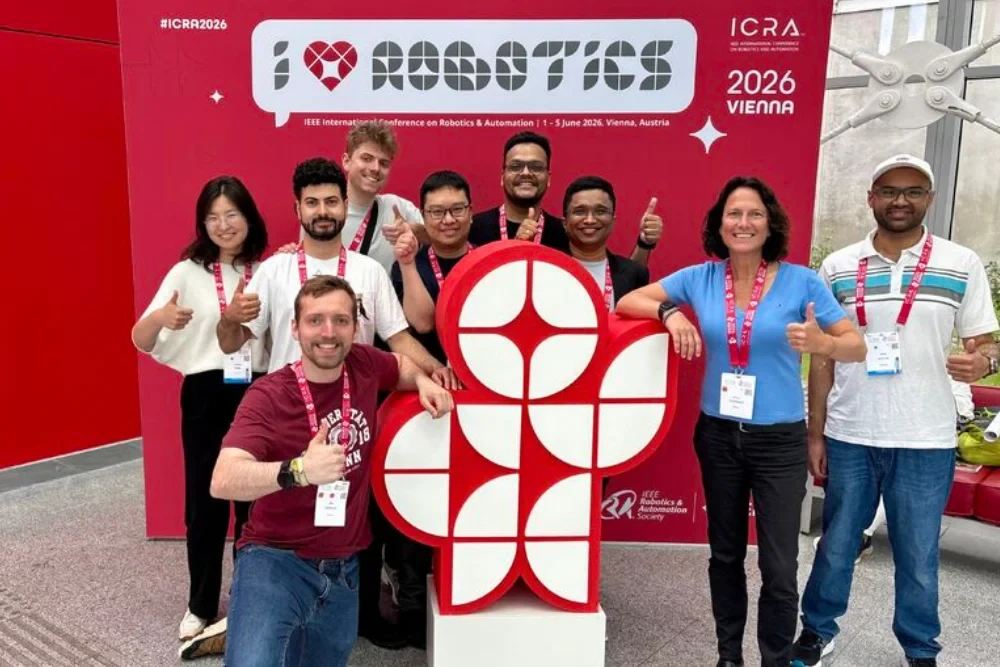
LamarRacing, a student-led AI and robotics project at the University of Bonn, won an award in the RoboRacer Competition held as part of the 2026 IEEE International Conference on Robotics and Automation (ICRA) in Vienna. The team from Bonn came top in the time trial by some margin, securing it the “Best Performance Overall” title, and followed up this showing with fourth place in the head-to-heads.
The team, led by doctoral student Nils Dengler and Professor Maren Bennewitz, started life as a study project at the University of Bonn. It has been supported financially by the Lamarr Institute for Machine Learning and Artificial Intelligence, in which the University of Bonn is involved. Competing at the conference were students Lukas Kutsch, Samir Shehadeh, Aftab Akhtar and Lavinia Kong, with Sicong Pan providing the project with scientific support.
Trialling AI under real-life conditions
The RoboRacer Competition sees autonomous model racecars go up against one another. The vehicles are required to navigate an actual track on their own, respond to obstacles and other features along their route and make their decisions in real time. This provides a particularly challenging testing ground for AI research.
“Competitions like these let us try out algorithms for interpreting sensor data, planning actions and monitoring movements under real-life, real-time conditions,” explains Professor Maren Bennewitz from the Institute for Computer Science at the University of Bonn. “At the same time, the students learn how to apply their theoretical knowledge in practice. They gain experience in research, development and teamwork—and see for themselves how taxing it is to get autonomous systems working reliably in actual situations.”
One of the key components in the successful system is an AI approach that combines data from professional motorsport with human expertise and that underpins how the vehicle plans its driving strategy and adapts it in line with the demands of the road ahead.
Research with practical relevance
Autonomous racing is much more than a mere sporting contest, as the technologies it uses are also relevant to other fields, including mobile robots, autonomous vehicles and assistance systems in industry and logistics. There is a need for methods that enable machines to perceive their surroundings, plan movements and make safe and reliable decisions in rapidly evolving situations.
LamarRacing’s success demonstrates how research-oriented teaching, student engagement and top-level AI research can all work together. Thus a study project has produced a team that has proven its worth on an international stage while also making valuable contributions to developing high-performance autonomous systems.