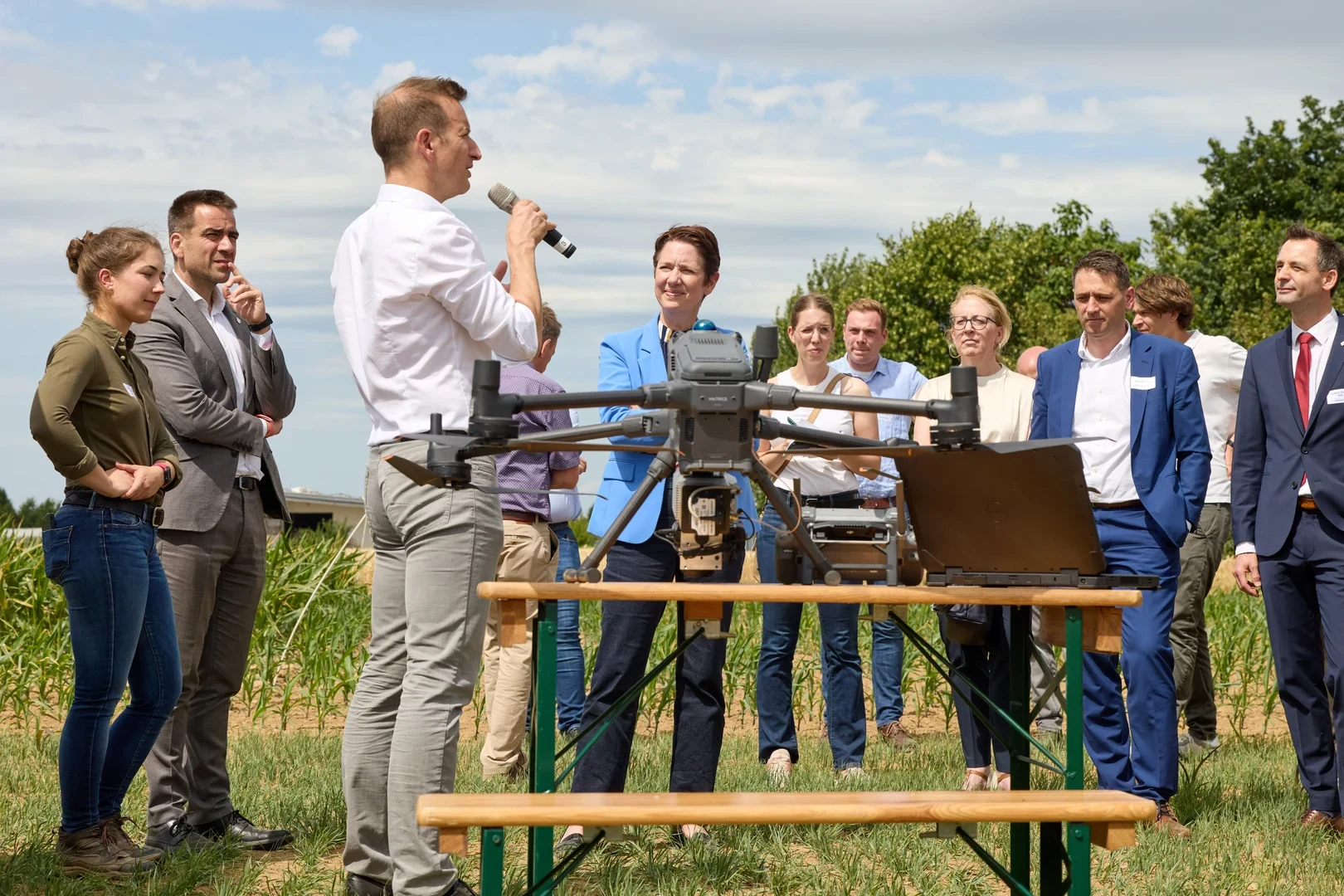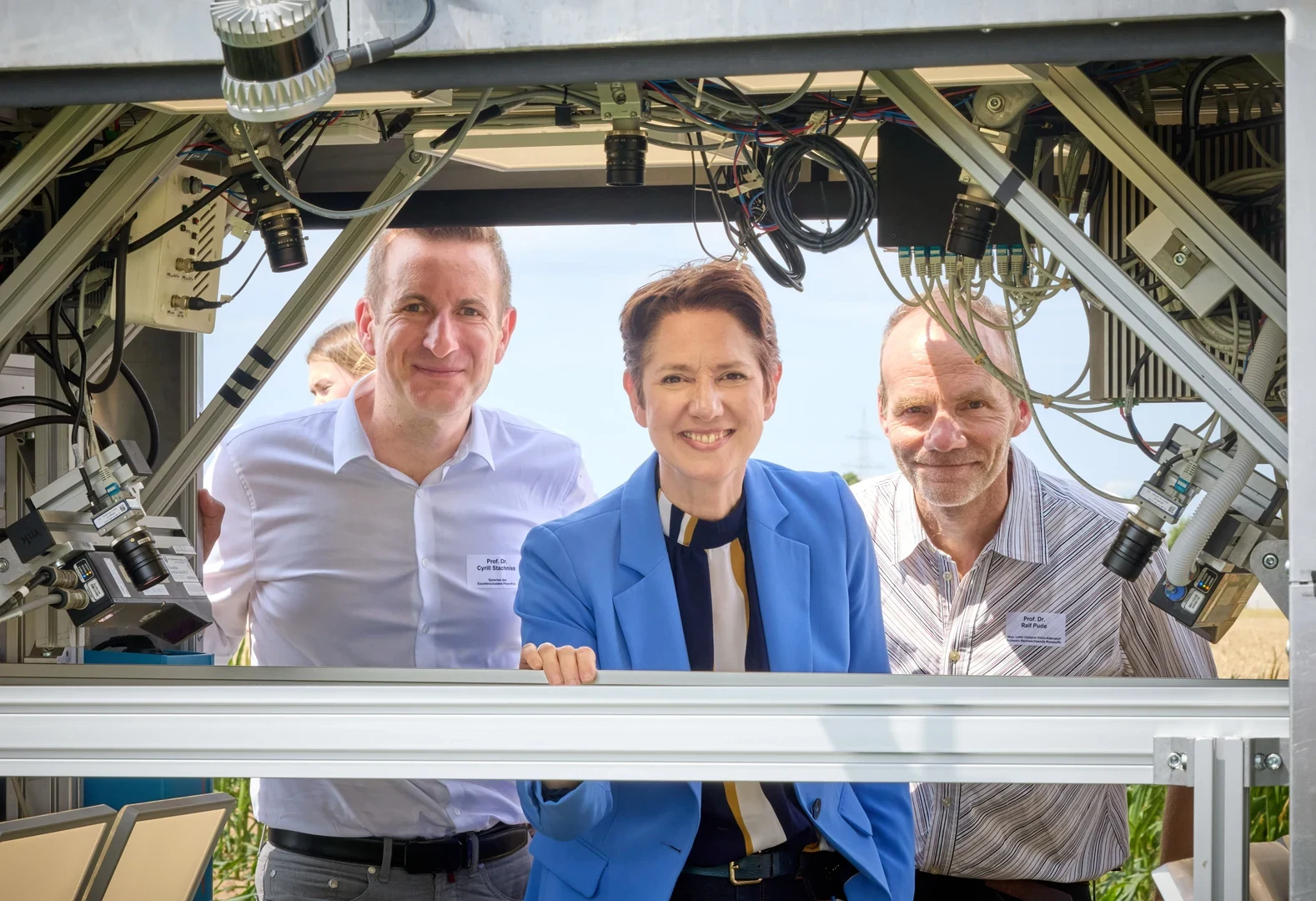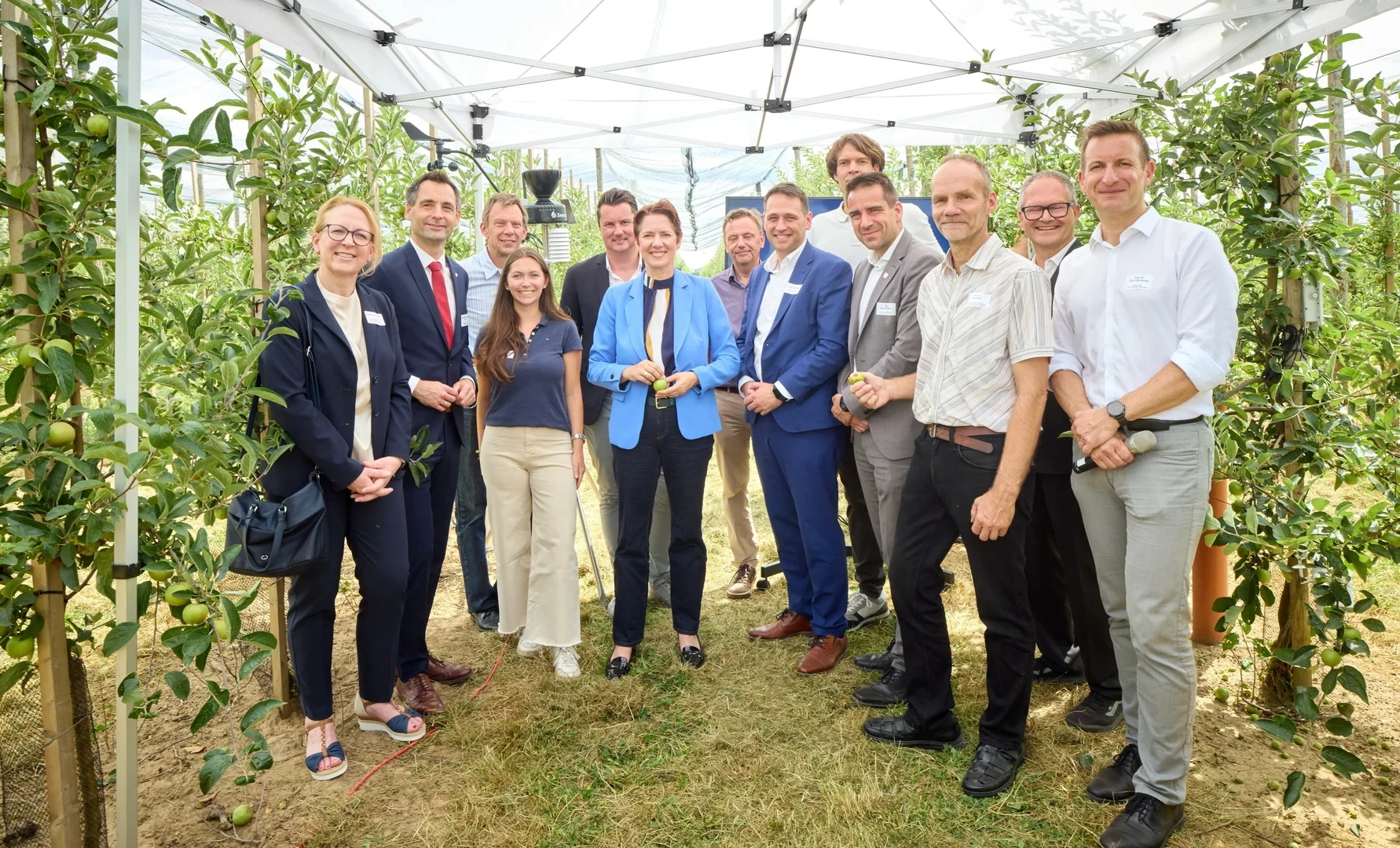
Researchers presented recent work from the PhenoRob Cluster of Excellence and the DigiKliMAP collaborative project, in which innovative technologies for sustainable and resource-efficient agriculture are being developed and tested in collaboration with industry partners.
The visit took place as part of the “A Strong Future in North Rhine-Westphalia: AI in Agriculture and Forestry” tour organized by the Ministry of Agriculture and Consumer Protection of the State of North Rhine-Westphalia. During a tour of the experimental plots, the minister gained insights into research projects that use modern sensor technology, robotics, and artificial intelligence to monitor crops more precisely, ensure yields, and help farms adapt to extreme weather conditions.
AI and Robotics for Sustainable Crop Production
Prof. Dr. Cyrill Stachniss presented research from the PhenoRob Cluster of Excellence. There, researchers from the fields of robotics, geodesy, computer science, plant sciences, and agricultural economics are collaborating to develop new technologies for sustainable crop production. The goal is to use autonomous systems, artificial intelligence, and modern sensor technology in ways that make agricultural production systems more resource-efficient, more effective, and at the same time more resilient.
Stachniss, spokesperson for the PhenoRob Cluster of Excellence: "Artificial intelligence combined with mobile robotics opens up new possibilities for us to precisely monitor plants and their environment and to understand complex relationships. In addition to basic research, technology transfer also plays an important role in our cluster. For example, through our startup culture, new AI and robotics technologies are put into practice via spin-offs."
Accurate weather data supports regional businesses
Another focus of the visit was the DigiKliMAP project, which is funded as part of the “European Innovation Partnerships for Productivity and Sustainability in Agriculture (EIP-Agri)” funding program. In collaboration with the lead partner, bio innovation park Rheinland e. V., agricultural businesses, and the University of Bonn, a digital network of weather stations and soil sensors is being developed.
The network provides high-resolution climate data for the southern Lower Rhine Bay and enables location-specific weather forecasts as well as early warnings of late frost or heavy rain. This allows farms to plan their management practices more effectively and use water and pesticides as needed. The data is available via an app or web browser.
Rapid Transfer of Research into Practice
The minister’s visit underscored the importance of the Klein-Altendorf campus as a research and technology transfer hub for the University of Bonn. Here, new technologies are developed under real-world conditions, scientifically evaluated, and further refined in collaboration with industry partners for use in agriculture.
Prof. Dr. Ralf Pude, Scientific Director of the Klein-Altendorf Campus: "At the Klein-Altendorf Campus, we don’t just develop new technologies in the lab; we do so under real-world conditions in collaboration with farms. This allows us to translate scientific findings directly into solutions that help farms adapt to the effects of climate change and use resources efficiently."