A small robot dog makes its way through the crowd, past information booths and billboards: Leading robotics researchers from German universities gathered in Cologne from March 11 to 13 for the 2nd German Robotics Conference (GRC). The University of Bonn, RWTH Aachen University, and the Fraunhofer Institutes IVI, IWU, IPA, IISB, and IML were also represented with their projects. Among the conference guests was the Rector of the University of Bonn, Prof. Dr. Dr. h.c. Michael Hoch, as well as the Federal Minister for Research, Technology, and Space (BMFTR), Dorothee Bär.
Recognition and Support of Robotics Research
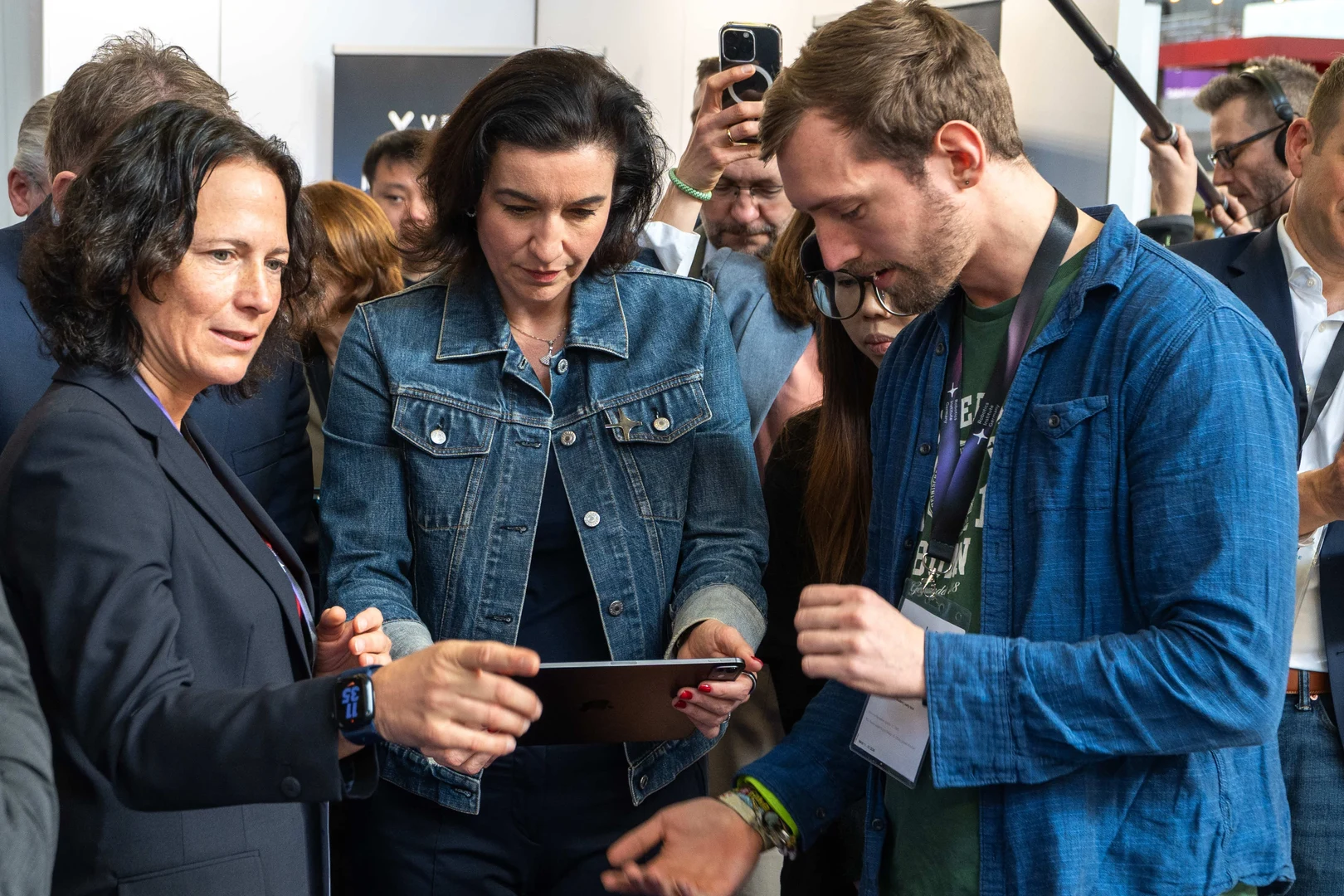
Xuying Huang stands in front of a robot holding a tablet and demonstrates its key features to Minister Dorothee Bär. She developed the approximately one-meter-tall mobile avatar, named PRIVATAR, for schoolchildren with chronic illnesses. It simulates their presence in the classroom and enables interaction through sensors. “The project places particular emphasis on privacy protection,” says the doctoral student at the University of Bonn. Under the supervision of Prof. Dr. Maren Bennewitz at the Humanoid Robots Lab of the Institute of Computer Science, she conducts research on navigation in dynamic environments and personalized human-robot interaction. The University of Bonn collaborates on this project with the University of Duisburg-Essen and the University of Göttingen.
With her project, Huang exemplifies the breadth of robotics research in Bonn, which was on full display at the conference. Research at the Bonn site focuses on control algorithms for mobile robots. The goal is for robots to adapt their behavior flexibly to their environment and interaction partners while minimizing the amount of sensory data collected. In this way, the team at the Institute of Computer Science is making an important contribution to the development of trustworthy assistive systems whose architecture offers a wide range of applications beyond the school setting. The BMFTR is funding the project.
In her keynote address, Federal Minister of Research, Technology and Space Dorothee Bär emphasized the importance of the High-Tech Agenda and the AI Robotics Booster for Germany as an industrial hub:
"The robotics insitute reflects a key roll in all of this. And its research roadmap should be based on industries needs. I am firmly convinced of the success of this." The ministry aims to specifically support flagship projects, such as those in the field of humanoid robotics. The focus is on the entire innovation process—from basic research to application. At the same time, Bär called on the scientific community to increase its visibility: “And in conclusion I would like to ask you to campaign loudly for your disciplines, for computer science, for engineering and everything that helps robotics advance.”
Robotics Institute Germany as a network
The German Robotics Conference is organized by the Robotics Institute Germany (RIG). The RIG comprises a network of 14 research institutions and more than 20 associated partners. The conference brings together representatives from research and industry to strengthen alliances and synergies. The event took place for the second time in 2026. The RIG was founded in 2024 and is currently funded by the BMFTR with 20 million euros.
Bonn's NimbRo Team Succeeds at RoboCup
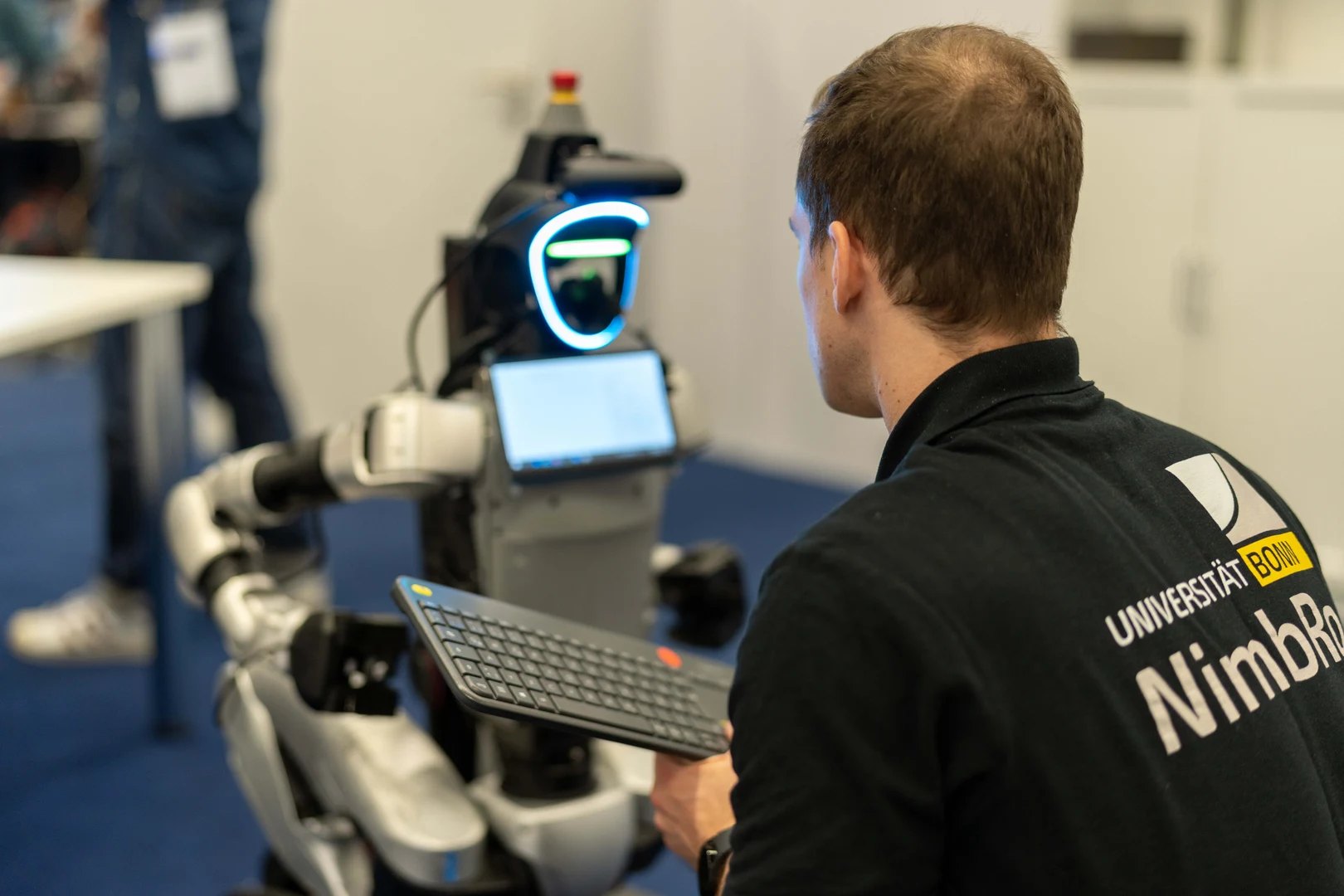
Held concurrently with the GRC, the Didacta education fair and the RoboCup took place in the exhibition halls in Cologne-Deutz. For RIG board member Prof. Dr. Sven Behnke, the event was a resounding success: At the RoboCup German Open 2026, his team NimbRo confidently defended its championship title in the @Home League. The household robots understood voice commands, delivered orders, and unloaded washing machines. The development teams competed against each other in the arena.
“The goal of our research is to enable people who need assistance to live independently in their familiar surroundings for longer,” says Prof. Dr. Sven Behnke, head of the Department of Intelligent Systems and Robotics, ELLIS Fellow, and principal investigator at the Lamarr Institute. Machine learning and artificial intelligence are key technologies that enable robots to master the complex challenges of everyday life. Behnke also heads the Embodied AI research area at the Lamarr Institute.
Keynotes, panels, and awards
In a presentation, four leading AI service centers shared their visions and key elements. Following this, Prof. Dr. Maren Bennewitz, Vice Rector for Digitalization and Information Management at the University of Bonn, Professor of Humanoid Robotics, and Lamarr Scholar, moderated a panel discussion on the integration of robotics and AI, featuring representatives from Cyber Valley (Stuttgart), Baiosphere (Munich), hessian.AI (Hesse), and Lamarr (Bonn), among others.
Prof. Dr. Stefan Wrobel, Head of Department III Information Systems and Artificial Intelligence at the Institute of Computer Science, Executive Director of the Bonn-Aachen International Center for Information Technology (b-it), and Co-Director of the Lamarr Institute for Machine Learning and Artificial Intelligence, advocates for a paradigm shift toward resource-efficient and trustworthy AI systems: “The idea behind this is that we believe applications are not a one way street, so we derive challenges from applications for our research." He explained the principle of triangular AI, in which data, knowledge, and context are systematically integrated into AI applications—a key focus of the Lamarr Institute’s research.
The conference concluded with the presentation of the RIG Heroes Awards, hosted by Prof. Dr. Angela Schoellig (Technical University of Munich). Prof. Gerd Hirzinger was honored with the RIG Pioneer Award for his lifetime achievements; the award will be named after him in the future. The RIG Outstanding Doctoral Thesis Award recognized outstanding doctoral dissertations, including those by Dr.-Ing. Ge Li (Karlsruhe Institute of Technology) and Dr. rer. nat. Pierre Schumacher (University of Tübingen). The Outstanding Startup Award went to Olive Robotics for its AI-based, ROS-2-native sensor systems designed to improve the scalability and reliability of autonomous robotics.
Robotics and AI, research and application: These were the key areas that provided important impetus for the future of modern technologies in Germany at this year’s RIG Conference—with significant participation from the Institute of Computer Science at the University of Bonn.