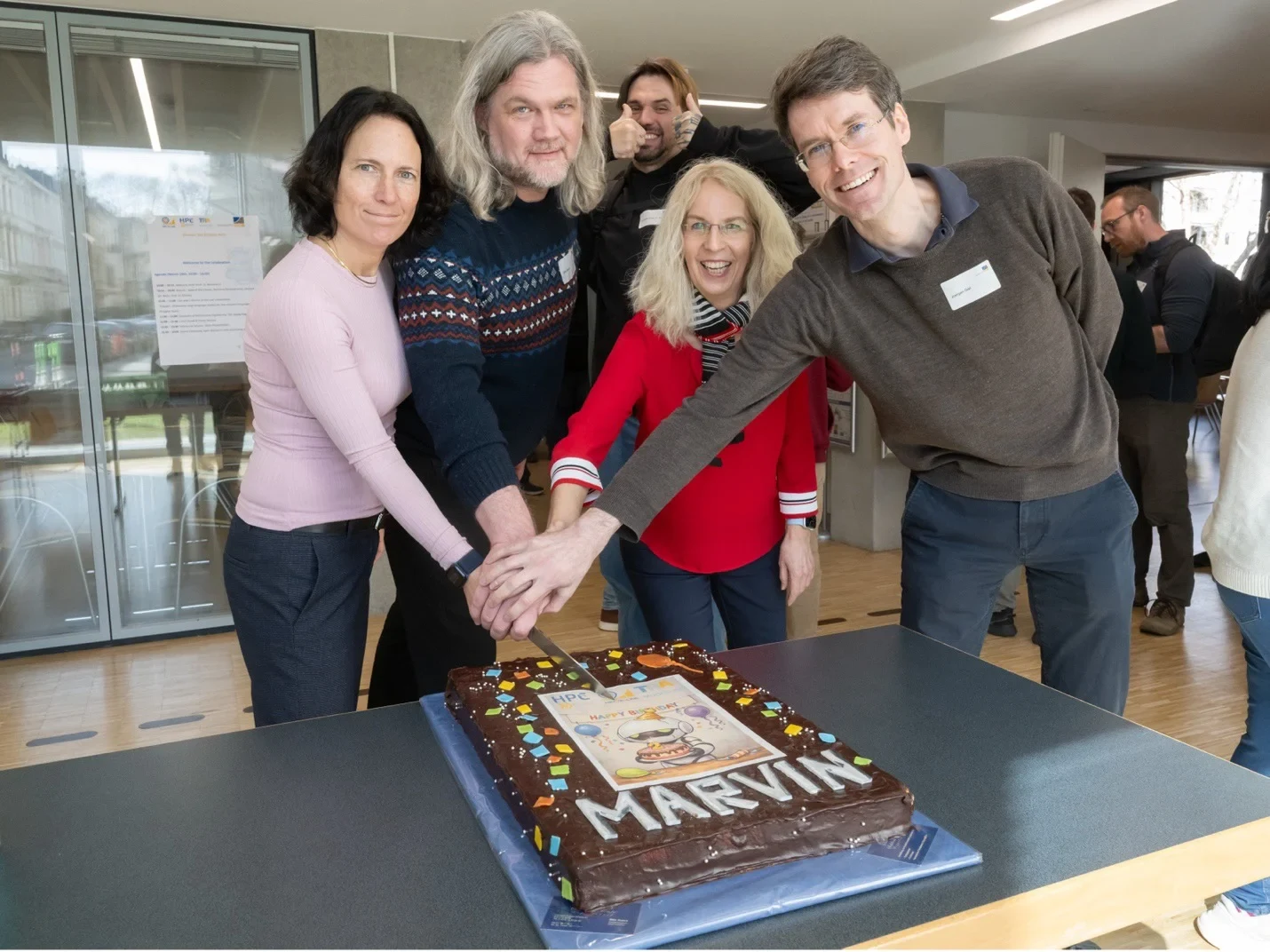
Two years after its commissioning, the University of Bonn celebrated its supercomputer Marvin with a community event at the Research and Technology Center for Detector Physics. For the Institute of Computer Science, Marvin is far more than a computing platform: it serves as a central tool with which Bonn’s computer scientists.
Marvin as a driver of innovation
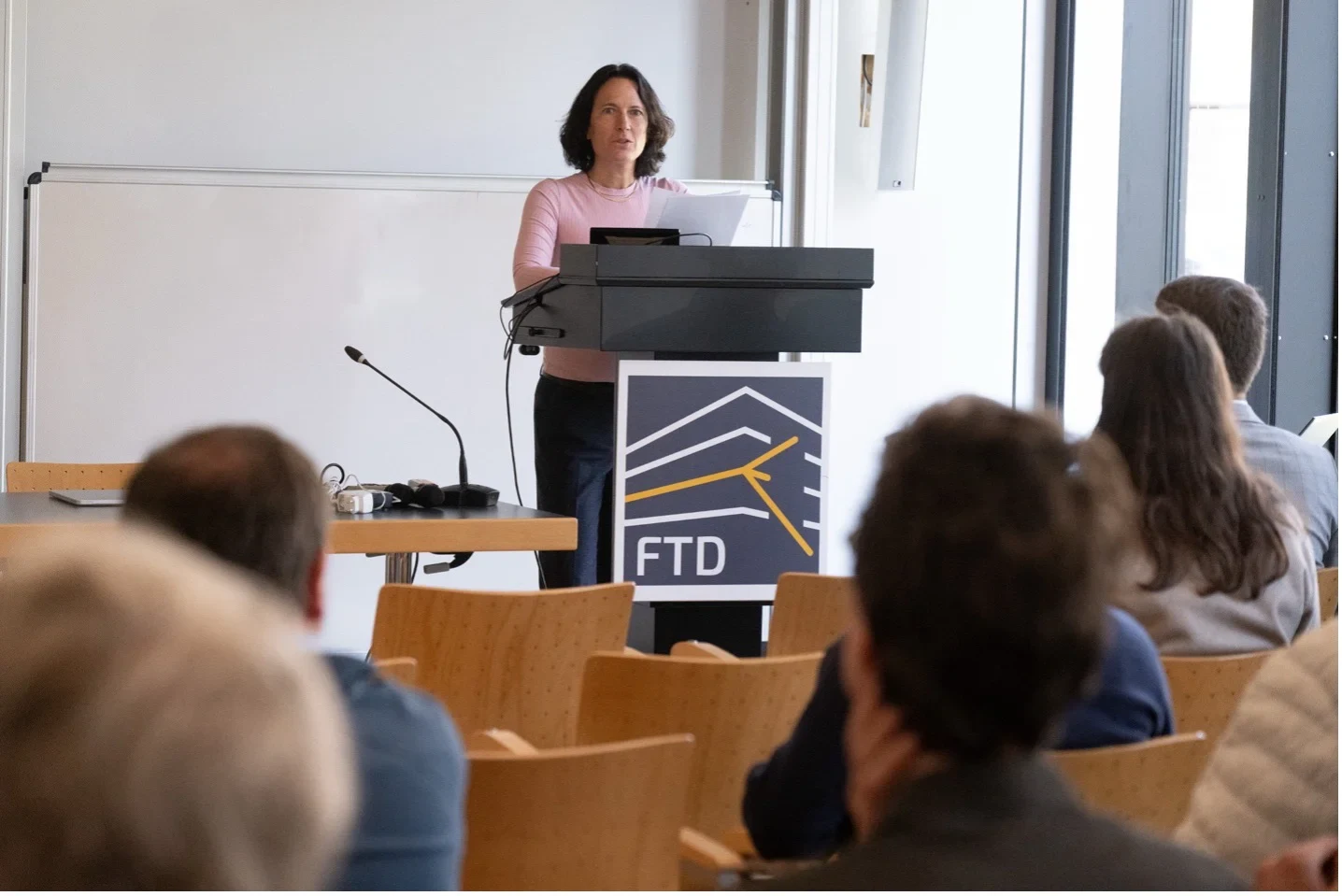
“For the past two years, Marvin has been a driver of innovation for our research at the University of Bonn,” said Prof. Dr. Maren Bennewitz at the opening of the event. She is the Vice Rector for Digitalization and Information Management and heads the Humanoid Robots Lab group at the Institute of Computer Science. “He has once again noticeably transformed our scientific work over the past year. Whether it’s complex simulations, data-intensive analyses, or cutting-edge research in the fields of artificial intelligence and machine learning: Marvin opens up possibilities for our researchers that were not foreseeable two years ago.”
Referring to the University of Bonn’s successful re-designation as a University of Excellence with eight Clusters of Excellence, she emphasized: “It goes without saying that digital infrastructures like Marvin play a central role in this. It exemplifies our commitment to combining scientific excellence with state-of-the-art infrastructure. With high-performance computing, we are creating the conditions to further develop scientific innovation at the highest level.” This is evident, among other things, in the fact that Marvin supports large collaborative projects such as the clusters of excellence “Phenorob,” “Color meets Flavor,” and “Dynaverse,” as well as the DFG Collaborative Research Centers DETECT and NuMeriQS.
From the molecule to the universe
Prof. Dr. Petra Mutzel presented the diverse applications of the high-performance computing (HPC) cluster: Over 500 researchers from various disciplines use Marvin so far. The supercomputer supports AI-driven methods for developing new therapeutics, which have already formed the basis of a multi-million-dollar cancer research project. It trains neural networks for autonomous vehicles, robotics, and sustainable agriculture. Marvin also plays a key role in climate and satellite data analysis, the simulation of battery systems, as well as in chemistry, physics, and astrophysics - for example, in the study of black holes or the interactions of quarks and gluons.
Marvin not only enables the analysis of large amounts of data but also lays the groundwork for new research approaches and publications. This makes projects feasible that would be unthinkable without this infrastructure.
Marvin Cup goes to RiverMamba
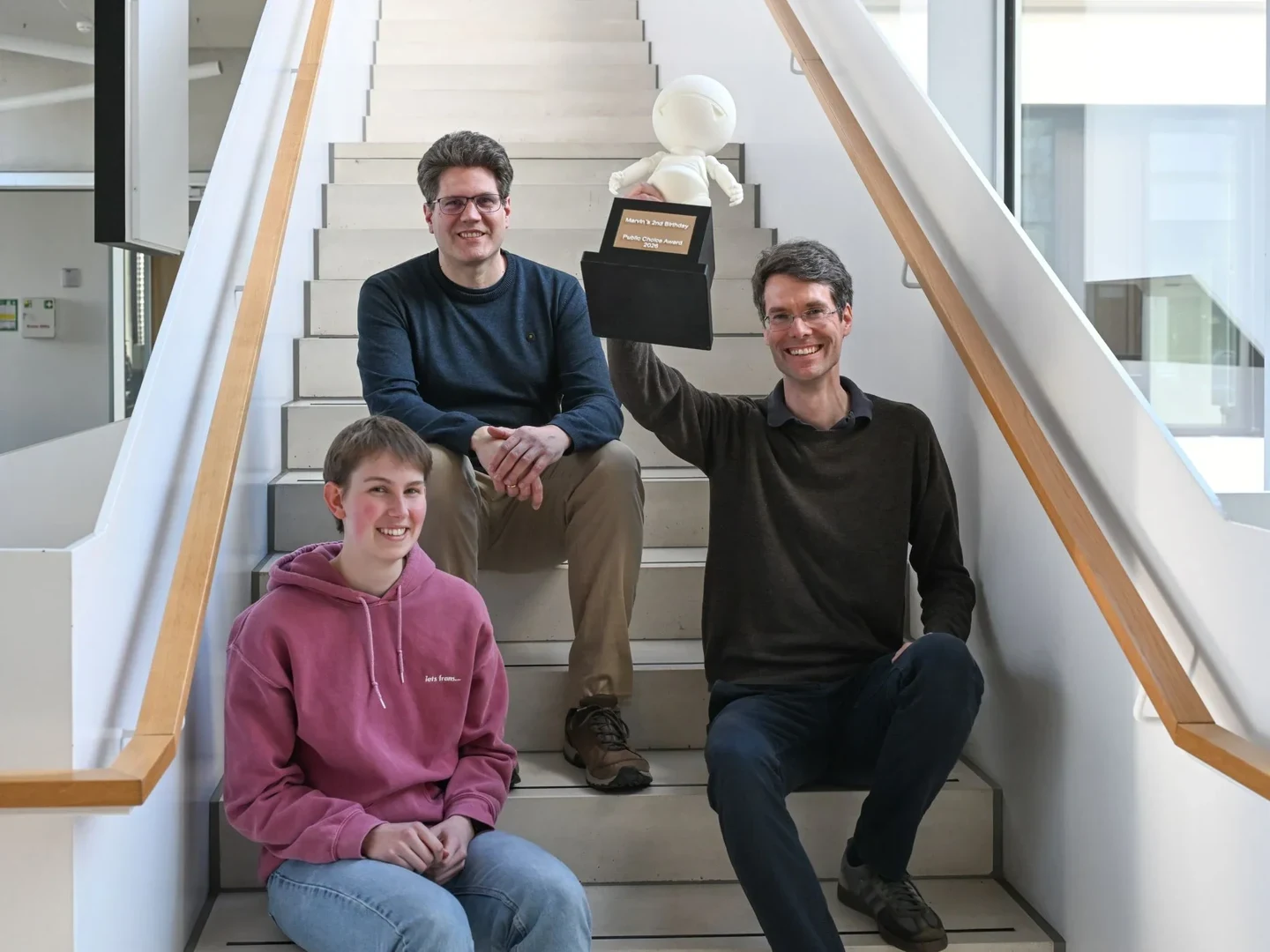
The wide range of applications for high-performance computing at the University of Bonn was also evident in the brief presentations of ten selected projects. This year’s Marvin Cup was won by the team led by Mohamad Hakam Shams Eddin and Prof. Dr. Jürgen Gall with their new AI model, RiverMamba. This model enables more precise predictions of flood risks than previous methods. "The event has once again shown that the HPC infrastructure and Marvin are essential for excellent research at the University of Bonn. I really appreciated the transdisciplinary nature of the event. It was very interesting to discuss use cases and potential solutions with my colleagues and doctoral students," said Gall, head of the Computer Vision Group in Computer Science III. He plans to use the additional computing time won with the prize to train the model at a higher resolution and thus make more accurate local predictions.
Second place went to Katrin Drysch from the Mulliken Center for Theoretical Chemistry. She utilized the capabilities of high-performance computing to develop a workflow for creating nanoplastic particles. These particles can be used to investigate the interactions of nanoplastics with various environments, such as the human body or the ocean.
The team led by Prof. Dr. Michael Hölzel (Institute of Experimental Oncology) and PD Dr. Gregor Hagelueken (Institute of Structural Biology) uses AI models to design new proteins that can be used in cancer therapy or to combat viruses. Using high-performance computers like Marvin, thousands of theoretically suitable designs can be generated, which can then be tested in the lab. This earned them third place in the voting. The audience decided the winners by vote. The prizes included additional computing time and, in some cases, enhanced support from the HPC support team.
Keynote on High-Performance Engineering
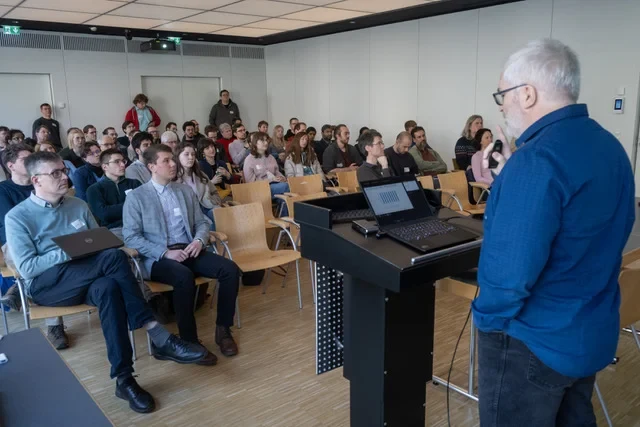
A highlight was the keynote by Dr. Georg Hager, Head of Research at the National Supercomputing Center Erlangen-Nuremberg. In “Do the math! Pen-and-paper HPC for fun and profit,” he demonstrated how simple calculations can be used to analyze and optimize code performance. Instead of relying solely on complex tools, this “calculating-on-paper” approach helps identify bottlenecks and design programs more efficiently. This was complemented by intensive workshops, personal exchanges, and a hackathon, during which researchers from Bonn were able to improve their programs in a practical setting together with the expert from Erlangen.
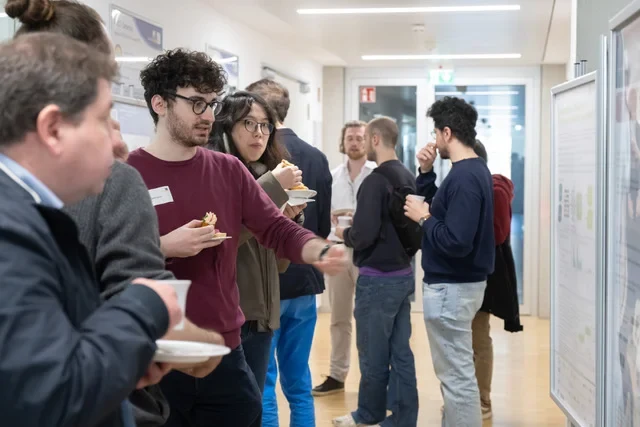
In addition to the presentations, researchers also showcased their work in a poster session. A total of twelve posters highlighted other projects that were carried out using Marvin. The session provided an opportunity for in-depth discussions, networking, and interdisciplinary exchange within the university’s growing HPC community.
Technical Support for Bonn Researchers
The HPC team at the University Computer Center is responsible for the technical operation and training on the optimal use of the supercomputer. Team leader Dr. Dirk Barbi emphasized the importance of a high-performance infrastructure: “With Marvin, we have created a stable, central platform that makes high-performance computing accessible to researchers from a wide variety of disciplines. We are seeing particularly strong growth in demand in the fields of Artificial Intelligence and data-intensive simulations.”
The researchers are supported in scientific aspects and methodologies by the High Performance Computing and Analytics Lab (HPC/A-Lab), which is based at the Digital Science Center. “Marvin embodies our commitment to making high-performance computing truly usable in research. The enormous potential here demonstrates that Bonn will continue to be a University of Excellence, and we are pleased to contribute our part,” explained Prof. Dr. Petra Mutzel, director of the HPC/A-Lab. “The projects presented today impressively demonstrate the scientific potential inherent in this infrastructure.”
Key Technology for Interdisciplinary Research
Marvin plays an important role, for example, in the transdisciplinary research area of TRA Modelling. This research network combines mathematical and computational methods with applications across numerous disciplines, ranging from the life sciences to medicine, the geosciences, and economics. The spokesperson for TRA Modelling, Prof. Dr. Jürgen Gall, explained: “The questions that researchers in TRA Modelling address often concern complex systems with many interacting components. To understand such systems, modeling, simulation, and high-performance computing are indispensable. Marvin is therefore a central component for many projects in TRA.” A look at last year’s event demonstrates that such transdisciplinary research approaches are being specifically and successfully funded: The Polyglot project received financial support from TRA Sustainable Futures and, thanks to the computing time it secured, was able to create one of the leading language models for Portuguese.
Supercomputer Marvin in figures
With 320 NVIDIA GPUs, 18,400 CPU cores, and a connected load of 430 kW, Marvin ranks among Germany’s most powerful academic supercomputers. Two-thirds of its capacity is specifically optimized for machine learning and AI applications—a unique selling point in the university setting. Since its launch on March 11, 2024, the HRZ HPC team has already supported 675 registered users from 183 research groups on Marvin. During this time, team members have processed over 1,900 support requests and conducted a total of 70 workshops (as of the end of 2025).